Synth Riders for Nintendo Switch
- Role
- Technical Art Director
- Year
- 2024
- Status
- shipped
- nintendo-switch
- rhythm-game
- unity
- technical-art
- art-direction
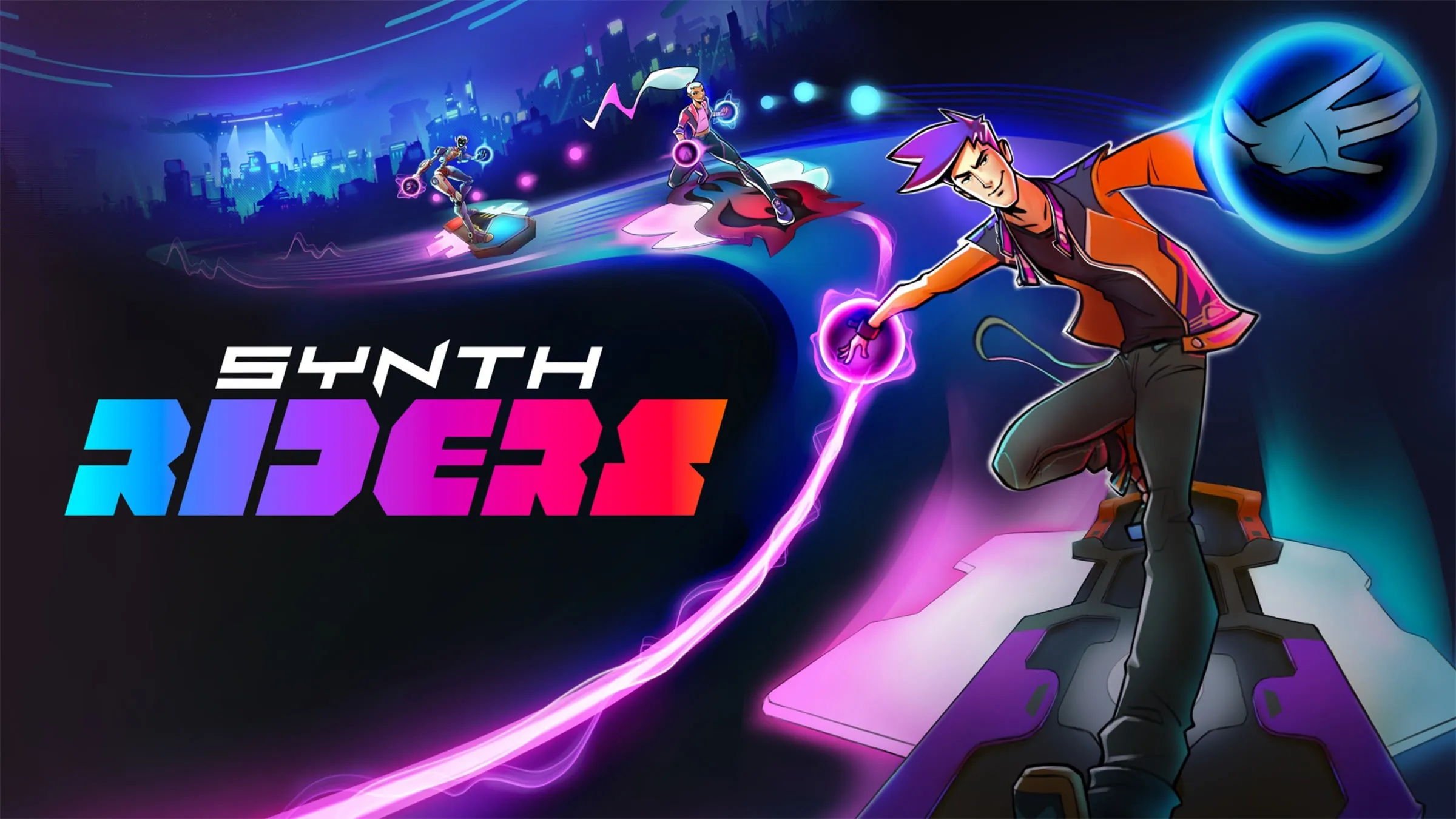
Synth Riders for Nintendo Switch reimagines Kluge’s flagship VR rhythm game for players without a headset.
The original Synth Riders is a rhythm game with a synthwave aesthetic, played with full-body VR motion. The Switch version had to deliver the same feel through a controller, on hardware with a fraction of the performance budget, for an audience that may never have put on a headset.
My Role
I led the project as Technical Art Director with a team of 4-5 people.
The decision that shaped the project: not to port the original assets. We rebuilt everything from scratch, designing a universe that could stay consistent and scale beyond this release. A port forces every old constraint forward. A reimagining lets the IP live on the new hardware on its own terms.
The hardest technical area was the avatar and character system. I designed how the figures broke into modular parts, how the source files were organized, how each piece was rigged, and how the whole assembly came back together inside Unity: prefab structure, supporting scripts, visual rules. Most of what the player sees on the avatars passed through that system.
The hardware was the other constant pressure. Switch is unforgiving on memory, GPU bandwidth, and draw call budget. The visual identity had to read as Synth Riders without the headroom that VR rendering allowed in the original. I wrote custom shaders to hold the look at a cost the platform could carry, and I introduced an improved file management system to keep the production stable as the asset base grew.
Stack & Tools
Unity 6. C# for game logic and tools. Shader Graph for the visual identity. Blender for modeling and rigging. Substance for texturing. ZBrush for high-poly sculpting. Plastic SCM for source control. Anchorpoint and Google Drive for asset management.
Nintendo Switch SDK and platform tooling under NDA.
No AI in the pipeline on this project.
Outcome
Synth Riders Switch shipped on December 18, 2025. It plays well, and it brings the IP outside VR without losing what made the original work. I’m proud of how it turned out.
What I took from this version: simplicity beats complexity when crossing input paradigms. After years building for VR, designing for a flat screen turned out to be a different discipline, not a downgrade. The translation is mechanical before it is visual.