Final Fury
- Role
- Founding artist, scaled to Technical Art Director
- Year
- 2020
- Status
- shipped
- vr
- fighting-game
- unity
- art-direction
- technical-art
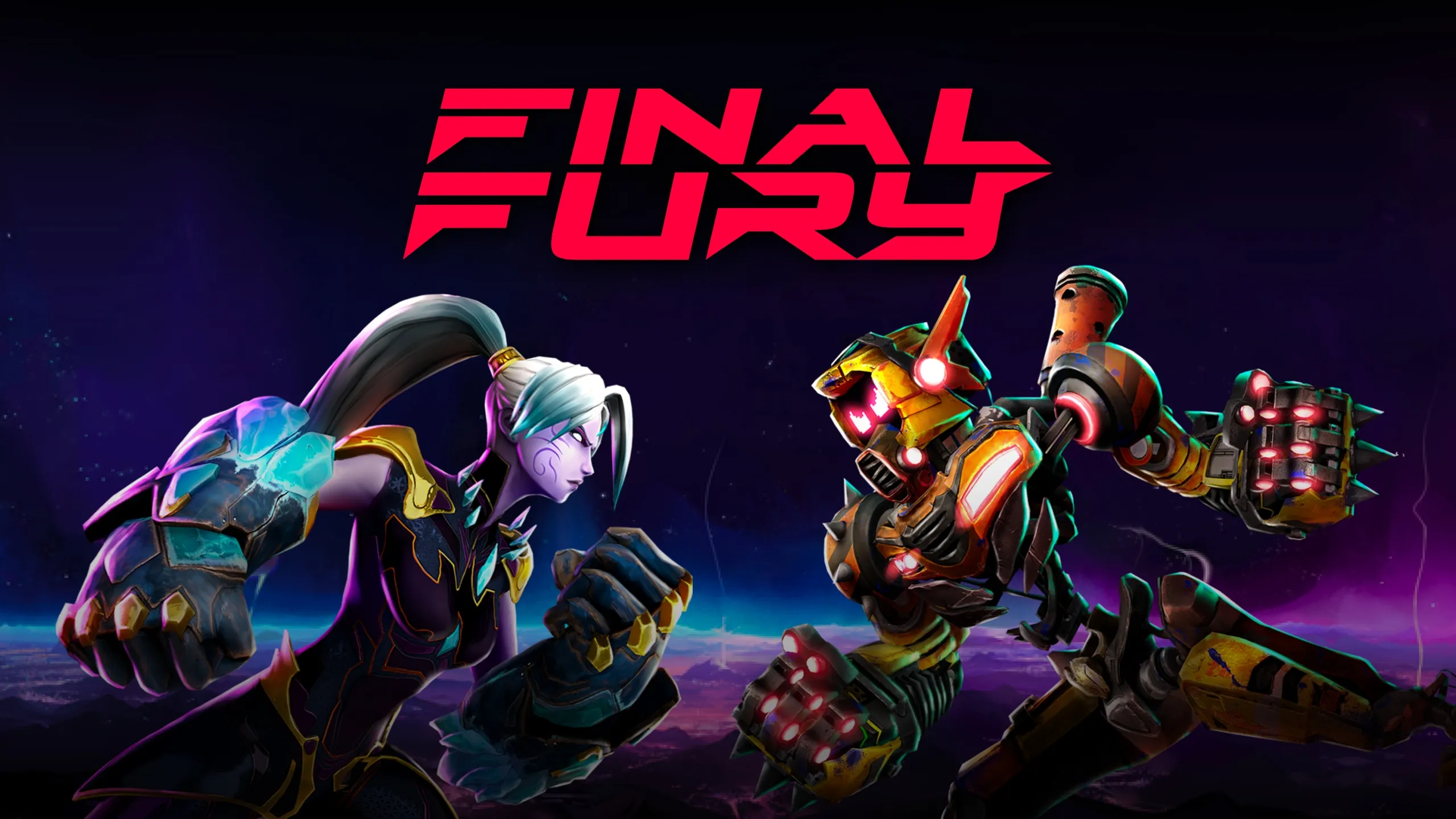
Final Fury is an arcade fighting game built for VR. The first attempt to take the Street Fighter genre into the headset.
The pitch: bring the readability and reaction-driven combat of arcade fighters into a medium that had mostly avoided them. The hard part was the rest.
My Role
I started as the only artist on a 3-4 person founding team. Over five years that team grew, and so did my role: Junior 3D Artist, Lead Artist, Art Director, Technical Art Director.
The hardest problem on the project was VR sickness. Fighting games are high motion: fast camera shifts, sudden lateral movement, hits that demand weight and impact. Most of those are exactly what nauseates players in VR. Combat that felt visceral without making the player sick took years of iteration on locomotion, attack execution, and camera framing.
The biggest art decision was not to chase realism, and not to lean too far into stylization. The visual target was a middle ground that stayed legible and tolerable across long VR sessions. Hyper-real punishes the GPU and the eyes. Hyper-stylized makes hit registration ambiguous. The compromise had to read clearly from any angle, at any speed, without overloading a player who had already been in the headset for forty minutes.
I built the production pipeline. Google Drive plus Anchorpoint for asset management, Plastic SCM for source control, custom shaders for the look. The shaders had to be cheap enough to ship on Quest 2 and rich enough to survive on PCVR.
I also moved the studio to Blender. When I joined Kluge the 3D toolchain was inconsistent across artists. During Final Fury I standardized on Blender, wrote internal documentation, trained the team. Blender is now the official 3D tool at the studio. That was a Final Fury byproduct that outlived the project.
Stack & Tools
Unity, across multiple versions over five years. C# for game logic and tools. Shader Graph for the visual identity. Blender for modeling and rigging. Substance for texturing. ZBrush for high-poly sculpting. Plastic SCM for source control. Anchorpoint and Google Drive for asset management.
No AI in the pipeline at the time. AI workflow integration came later in my work at Kluge.
Outcome
Final Fury launched in Early Access on Meta Quest 2/3 and PCVR in 2025.
What I took from the project: functional before visual. Five years of building a genre that did not yet exist in VR taught me to prototype the mechanic before designing the asset, and to drop ideas fast when they did not work. Both lessons now sit at the core of how I lead rapid prototyping at Kluge.